
Table of Contents
- How We Evaluated the Best Carry-On Luggage for Flyers
- Quick Comparison: Top Carry-On Luggage Picks
- Carry-On Luggage Size Requirements and Airline Restrictions
- TSA Approved Carry-On Luggage: Locks, Rules, and What to Know
- Best Hardside Carry-On Luggage: Top Picks Ranked
- Away The Carry-On ($275): Best All-Around Hardside
- Monos Carry-On Plus ($295): Best for Minimalist Travelers
- Samsonite Freeform ($219.99): Best Budget Hardside
- Nomatic Carry-On Classic ($469.99): Best for Organization
- Delsey Paris Chatelet Air 2.0 ($269): Best for Style and Security
- Rimowa Classic Cabin ($1,400): Best Luxury Option
- Softside vs. Hardside: Key Features to Look for in a Carry-On
- Repairability, Warranty Coverage, and Long-Term Value
- Which Carry-On Should You Choose?
- Frequently Asked Questions
Last Updated: August 31, 2026
How We Evaluated the Best Carry-On Luggage for Flyers
Choosing the right carry-on luggage matters until you’re sprinting through a terminal with a bag that won’t fit the overhead bin. At Plan0gram, founder Tony Yandow has logged over 34 years of flying experience and more than 3 million miles in the air, meaning this gear review comes from someone who has actually lived with these bags across dozens of airports.
The best carry-on luggage clears airline size restrictions, survives repeated overhead bin loading, and keeps your gear organized without adding unnecessary weight to your luggage allowance.
We evaluated each bag across five criteria: compliance with major airline size restrictions, weight relative to internal capacity, wheel and handle performance, interior organization quality, and long-term durability. We also factored in warranty coverage and repairability, two angles most carry-on reviews skip entirely.
Below, you’ll find ranked picks for hardside carry-ons, a breakdown of size rules by airline, and a feature-by-feature comparison to help you match the right bag to your travel style.
Quick Comparison: Top Carry-On Luggage Picks
Here’s a fast reference before we get into the details.
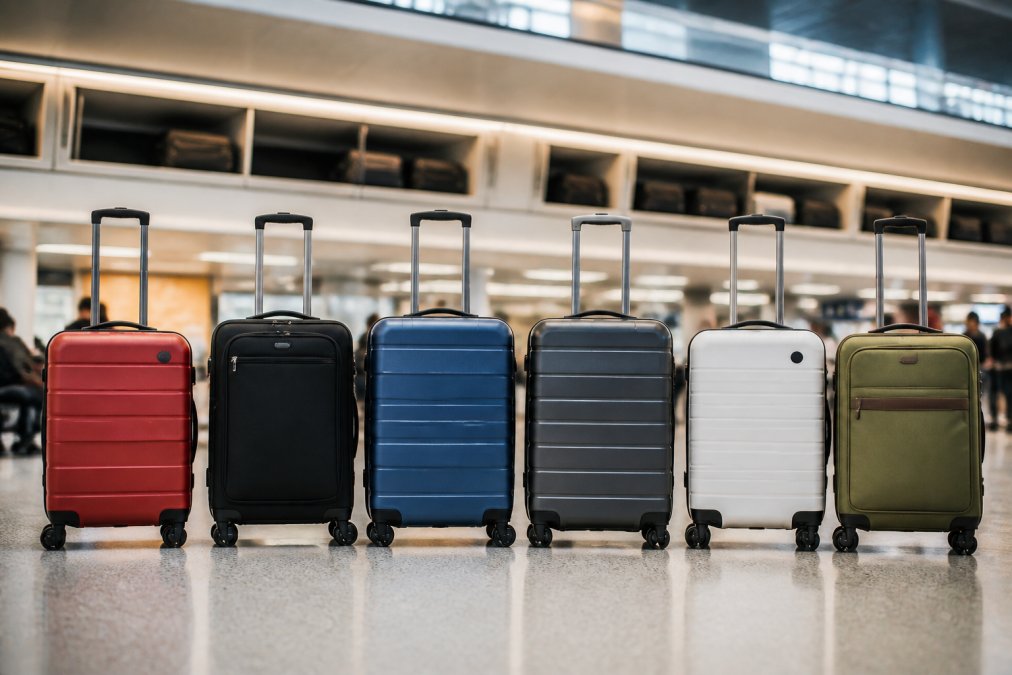
| Bag | Price | Shell Type | Best For |
|---|---|---|---|
| Away The Carry-On | $275 | Polycarbonate hardside | All-around frequent flyer |
| Monos Carry-On Plus | $295 | Polycarbonate hardside | Minimalist travelers |
| Samsonite Freeform | $219.99 | Polypropylene hardside | Budget-conscious travelers |
| Nomatic Carry-On Classic | $469.99 | Polycarbonate hardside | Organization-focused travelers |
| Delsey Paris Chatelet Air 2.0 | $269 | Polycarbonate hardside | Style and security |
| Rimowa Classic Cabin | $1,400 | Aluminum-magnesium alloy | Luxury travelers |
| Travelpro Platinum Elite 21″ | $460 | Ballistic nylon softside | Business travelers |
| Briggs & Riley Baseline 22″ | $729 | Ballistic nylon softside | Lifetime warranty seekers |
Quick Picks:
- Best Overall: Away The Carry-On
- Best Budget: Samsonite Freeform
- Best Luxury: Rimowa Classic Cabin
- Best for Organization: Nomatic Carry-On Classic
Carry-On Luggage Size Requirements and Airline Restrictions
Carry-on luggage size requirements are not universal; every airline sets its own linear dimension limit. The standard carry-on size most US domestic carriers accept is 22 x 14 x 9 inches, including wheels and handles. Budget carriers and international routes often impose tighter restrictions. Always measure your bag fully assembled before travel.
Some airlines measure bags at the gate using a sizing template. If your carry-on doesn’t fit, you’ll pay a checked baggage fee on the spot, often at the highest possible rate. Always verify dimensions before you fly, not at the terminal.
Airline-by-Airline Dimension Breakdown
According to TSA carry-on guidelines and airline size policies, the TSA itself does not set carry-on size limits; that authority belongs to individual airlines.
| Airline | Max Carry-On Dimensions (L x W x H) | Personal Item Allowed |
|---|---|---|
| American Airlines | 22 x 14 x 9 in | Yes |
| Delta Air Lines | 22 x 14 x 9 in | Yes |
| United Airlines | 22 x 14 x 9 in | Yes |
| Southwest Airlines | 24 x 16 x 10 in | Yes |
| Spirit Airlines | 22 x 18 x 10 in | Yes (fee may apply) |
| Frontier Airlines | 24 x 16 x 10 in | Yes (fee may apply) |
| JetBlue | 22 x 14 x 9 in | Yes |
Most premium hardside carry-ons are designed to hit the 22 x 14 x 9 inch target. The Monos Carry-On Plus, for example, is sized to fit overhead bins on most major US airlines while offering slightly larger internal volume than a standard carry-on.
TSA Approved Carry-On Luggage: Locks, Rules, and What to Know
TSA-approved carry-on luggage is any bag fitted with a lock that TSA agents can open using a master key without cutting the lock or damaging the bag. Every bag on this list includes either a TSA-approved combination lock or TSA-locking zippers. The Delsey Paris Chatelet Air 2.0 includes a patented SECURITECH 2 zipper, which is significantly harder to pry open than a standard zipper.
Beyond locks, TSA carry-on rules govern what you can pack. Liquids must comply with the 3-1-1 rule: containers of 3.4 oz or less, in one quart-sized clear bag, one bag per passenger, as documented in TSA 3-1-1 liquids rule.
If your carry-on has a built-in USB port, remember that power banks must travel in carry-on luggage, not checked bags. TSA prohibits lithium batteries in checked baggage above certain watt-hour ratings.
Best Hardside Carry-On Luggage: Top Picks Ranked
Away The Carry-On ($275): Best All-Around Hardside
Away The Carry-On is the most balanced hardside carry-on for frequent flyers at this price point. The polycarbonate shell handles overhead bin abuse well, the 360-degree spinner wheels roll smoothly, and the interior compression system actually compresses. A hidden laundry bag separates worn clothes from clean ones, and the compression pad keeps a full packing load from shifting mid-flight.
What works: Sleek design, smooth-rolling spinner wheels, and genuinely useful interior layout.
What doesn’t: The shell scuffs over time, a polycarbonate reality. The optional ejectable battery is an add-on cost.
Frequent flyers who want one bag that handles domestic routes and short international trips without drama.
Monos Carry-On Plus ($295): Best for Minimalist Travelers
The Monos Carry-On Plus uses aerospace-grade, water-resistant polycarbonate that’s more impact-resistant than standard polycarbonate. The telescoping handle has four height settings, and the 100-day trial period lets you actually travel with it before deciding. The tradeoff: internal volume is not dramatically larger than standard carry-ons, and there are no integrated tech features.
Samsonite Freeform ($219.99): Best Budget Hardside
The Samsonite Freeform is the right answer for travelers who don’t want to spend $300+ on a carry-on. The polypropylene shell is extremely lightweight, and the 1-inch expansion adds useful capacity for the return trip. The double spinner wheels provide solid maneuverability, and the TSA 3-dial combination lock is straightforward. Interior organization is functional but basic.
Nomatic Carry-On Classic ($469.99): Best for Organization
Nomatic’s magnetic compression system is genuinely different. Folding panels with magnetic straps hold your packing layers flat and compressed, allowing a 30-liter bag to pack more efficiently than many larger carry-ons. The silent Hinomoto wheels are noticeably quieter than standard spinner wheels, and the TSA-locking YKK zippers are among the most durable in luggage. The 30L capacity is the one limitation; heavy packers or those traveling more than four days may feel the squeeze.
Delsey Paris Chatelet Air 2.0 ($269): Best for Style and Security
Delsey’s Chatelet Air 2.0 stands out on a baggage carousel. The textured basket-weave polycarbonate shell with vegan leather trim reads as premium at a mid-range price. The SECURITECH 2 zipper adds a second layer of zipper resistance that makes opportunistic tampering significantly harder. The USB port is a nice touch, though the power bank is not included.
Rimowa Classic Cabin ($1,400): Best Luxury Option
The Rimowa Classic Cabin is for travelers who view luggage as a long-term investment. The aluminum-magnesium alloy shell is heavier than polycarbonate and will develop scratches and dents over time, which Rimowa considers part of the story. The Multiwheel system rolls with precision that no polycarbonate spinner matches, and construction standards routinely outlast bags costing a third of the price. TSA-approved locks and a Flex-Divider system are standard.
Softside vs. Hardside: Key Features to Look for in a Carry-On
The choice between softside and hardside carry-on luggage comes down to how you pack and what you’re protecting. Hardside bags protect rigid items better and resist moisture. Softside bags flex to fit into tighter overhead bin spaces and often weigh less.
Wheels, Handles, and Maneuverability
Spinner wheels, four multidirectional wheels rather than two fixed wheels, are now standard for carry-on luggage. Wheel quality varies significantly. The Travelpro Platinum Elite uses a MagnaTrac self-aligning spinner system. The Nomatic’s Hinomoto wheels run silent. The Rimowa Multiwheel system offers the smoothest steering.
Handle ergonomics matter as much as wheel quality. Look for an airline-grade aluminum telescoping handle with multiple height stops. A handle that locks at only two heights is a design compromise.
Interior Organization, Compression, and Packing Efficiency
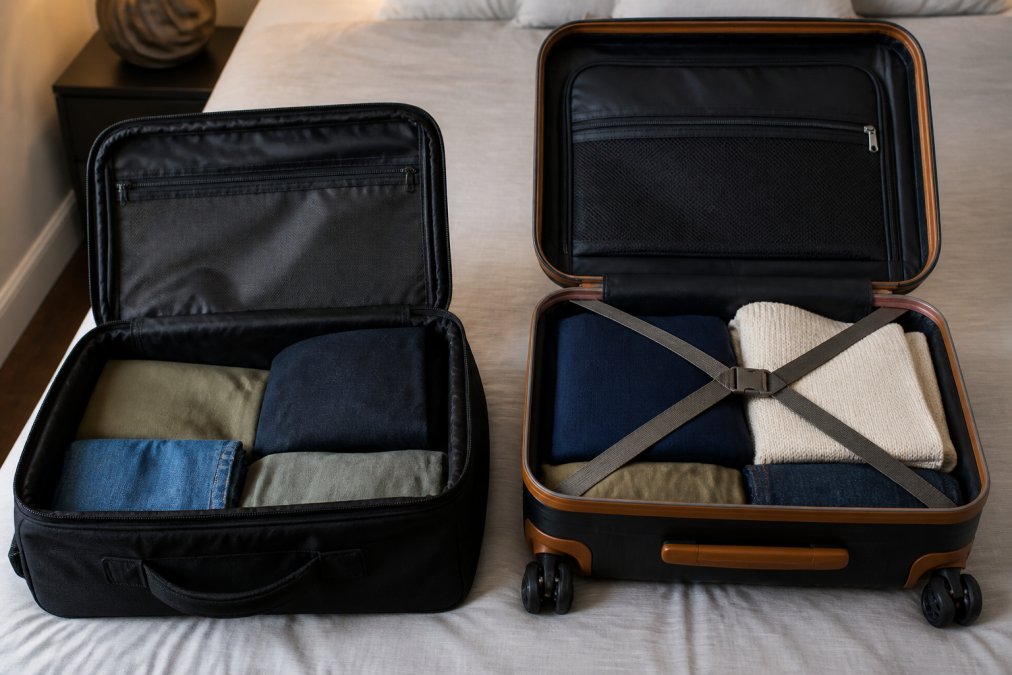
Compression straps are the single most useful interior feature in a carry-on. Away’s compression system is a hinged divider. Nomatic’s magnetic compression panels hold both sides flat. Briggs & Riley’s CX expansion-compression system expands when you need space, then compresses it back down.
The Outsider handle on the Briggs & Riley Baseline is genuinely clever: the handle mechanism sits outside the bag’s main compartment, giving you a completely flat packing surface inside.
The best interior organization system is the one that matches how you actually pack. If you fold, a flat divider works. If you roll, you need a bag with enough depth to lay rolls flat without the compression strap cutting across them.
Weight-to-Capacity Ratio and Durability
Weight-to-capacity ratio is the metric most carry-on reviews ignore. The Samsonite Freeform’s polypropylene shell makes it one of the lightest hardside options, which translates to more packing capacity within a weight-restricted airline allowance. The Rimowa Classic Cabin’s aluminum shell is the heaviest, a real tradeoff for its durability advantage.
For softside options, ballistic nylon (used in the Travelpro Platinum Elite and Briggs & Riley Baseline) offers the best durability-to-weight ratio of any carry-on fabric. According to Department of Transportation air travel consumer report, mishandled baggage rates remain a consistent concern, another argument for carry-on-only travel when possible.
Repairability, Warranty Coverage, and Long-Term Value
Repairability is the sustainability angle most carry-on reviews skip, and it’s the one that separates a $300 bag you replace every three years from a $700 bag you carry for a decade.
Briggs & Riley’s lifetime guarantee covers repair or replacement for any damage, including airline damage, for the life of the bag. No other brand on this list offers equivalent coverage. Rimowa operates a network of repair centers and sells replacement parts directly. Eagle Creek’s Gear Warrior XE, built from 100% recycled 600-denier water-resistant fabric, takes a different approach to sustainability with a “No Matter What” warranty covering damage from normal use.
Before buying any carry-on, check whether the brand sells replacement wheels and handles separately. Spinner wheels are the most common failure point. A brand that sells replacement parts extends your bag’s lifespan significantly and keeps it out of a landfill.
Which Carry-On Should You Choose?
The right carry-on luggage depends on how often you fly, what you’re protecting, and what you’re willing to spend.
For most travelers, the Away The Carry-On at $275 hits the right balance of price, durability, and interior organization. It clears standard airline size restrictions, rolls smoothly, and the compression system genuinely works.
If budget is the primary constraint, the Samsonite Freeform at $219.99 is the honest answer. It’s lighter than most hardside competitors and expandable.
For frequent flyers who want the best long-term value, the Briggs & Riley Baseline’s lifetime warranty changes the cost calculation entirely. At $729, it’s expensive upfront, but it’s the last carry-on you’ll need to buy.
| Travel Profile | Best Pick | Why |
|---|---|---|
| Occasional leisure traveler | Away The Carry-On | Best all-around value |
| Budget-conscious traveler | Samsonite Freeform | Lightweight, affordable |
| Business frequent flyer | Travelpro Platinum Elite | Organization and durability |
| Luxury traveler | Rimowa Classic Cabin | Premium materials, longevity |
| Organized packer | Nomatic Carry-On Classic | Magnetic compression system |
| Sustainability-focused | Eagle Creek Gear Warrior XE | Recycled materials, strong warranty |
| Long-term value seeker | Briggs & Riley Baseline | Lifetime warranty, ballistic nylon |
Plan0gram’s gear reviews are built on the same principle as everything Tony Yandow has shared over 34 years of flying: honest assessment over sponsored enthusiasm. The bags on this list were evaluated on what matters to real flyers, compliance, durability, and interior organization that holds up across a full travel season.
For more on traveling smarter, from gear selection to airport navigation and the view from 35,000 feet, explore Plan0gram’s full archive of travel guides and aviation photography.
Frequently Asked Questions
What are the standard carry-on size requirements for major airlines?
Most major domestic carriers cap carry-on linear dimensions at 45 linear inches, which typically translates to 22 x 14 x 9 inches including wheels and handles. However, limits vary: Spirit and Frontier enforce stricter rules, while international carriers often allow slightly different dimensions. Always check your specific airline’s current policy before you travel, since airlines update these rules without much notice and gate agents do measure bags when overhead bin space is tight.
Are hard-shell or soft-shell carry-ons better for air travel?
Hardside carry-ons made from polycarbonate or polypropylene offer better impact resistance and keep contents dry, making them ideal for frequent flyers who check in tight overhead bins regularly. Softside bags made from ballistic nylon flex to fit irregular spaces and typically weigh less, which helps when airlines enforce strict weight limits. The right choice depends on your travel style: hardside for protection, softside for flexibility and lighter luggage weight.
What features should I look for in a carry-on bag?
Prioritize spinner wheels for smooth maneuverability through terminals, a telescoping handle at a comfortable height, and a TSA-approved lock for security. Inside, compression straps and organized compartments make packing more efficient. Check the bag’s empty weight against its internal volume to get a sense of the weight-to-capacity ratio. Zipper quality matters more than most buyers realize, reinforced or YKK zippers hold up far longer under repeated use than generic alternatives.
What suitcase do flight attendants recommend for durability?
Flight attendants who handle luggage daily tend to favor softside bags made from ballistic nylon, like the Briggs & Riley Baseline, for their flexibility and resistance to tearing. For hardside options, polycarbonate shells from brands with strong warranty coverage rank highest because dents and cracks can be repaired or replaced. The consensus across frequent flyer communities is that wheel quality and handle durability matter more than shell material when it comes to long-term carry-on performance.
What makes a carry-on TSA approved?
TSA approval on carry-on luggage refers specifically to the lock, not the bag itself. A TSA-approved lock uses a master key system that TSA agents can open for inspection without cutting the lock. Most quality carry-ons include an integrated TSA combination lock built into the zipper or shell. The bag’s contents still must comply with TSA liquid rules and prohibited items lists, which are enforced at the security checkpoint regardless of what lock the bag uses.
Picking the wrong carry-on is one of the most common and expensive mistakes frequent flyers make. The right bag clears every overhead bin, respects your weight limit, and keeps your gear organized from departure to arrival. At Plan0gram, Tony Yandow’s 34 years of flying experience and 3 million miles in the air inform every gear recommendation, no filler, no sponsored rankings. Get started with Plan0gram and fly smarter on every trip.
This article was written using GrandRanker