

Table of Contents
- Understanding Authentic Aviation Prints
- Identifying High-Quality Aviation Prints
- Verifying Authenticity: Signatures and Certificates
- Aviation Photography Prints for Sale: Where to Buy ✈️
- How to Frame Aviation Photography
- Investment vs. Decorative Value
- Your Next Step: Building Your Collection 🛫
- Frequently Asked Questions
Last Updated: September 3, 2026
Understanding Authentic Aviation Prints
When hunting for how to buy authentic aviation prints, you’re stepping into a world where passion meets precision. Aviation enthusiasts know the difference between a genuine limited edition and mass-produced reproduction can mean significant value differences.
At Plan0gram, we’ve spent over 34 years observing what separates collectors who build meaningful collections from those who end up with regret purchases. Understanding what you’re actually buying is foundational.
Limited Edition vs. Open Edition Prints
A limited edition print is numbered and restricted in quantity, say, 500 prints total. Once sold out, no more are produced. This scarcity drives collectibility and value.
Open edition prints have no production limit and can be reprinted indefinitely. While beautiful for decoration, they lack investment potential. For serious collecting, limited editions are essential. Look for prints marked “1/500” or “250/500”, that numbering proves authenticity and scarcity. Without it, you’re likely looking at an open edition.
Original Paintings vs. Reproductions
Original acrylic or oil paintings are one-of-a-kind pieces commanding premium prices. Reproductions (giclee, lithograph, or other techniques) are copies produced in limited or open editions, far more accessible in price yet still valuable when signed and limited.
The key question: are you buying the artwork itself or the image? Original paintings appeal to serious collectors; reproductions offer high-quality versions at accessible price points. Both have merit, know which you’re purchasing.
Identifying High-Quality Aviation Prints
Quality separates a print worth framing from one that fades within years.
Paper Quality and Archival Materials
Museum-grade prints use archival paper resisting yellowing and deterioration for decades (loc.gov). When evaluating, look for:
- Paper weight: 200gsm or higher (grams per square meter)
- Acid-free composition: pH-neutral or slightly alkaline to prevent yellowing
- Brightness rating: 90% or higher
- Cotton content: 100% cotton rag paper is the gold standard
Ask sellers directly: “What’s the paper weight and acid-free rating?” If they can’t answer, that’s a red flag. Museum-grade paper feels substantial with slight texture, worth the investment for lasting collections.
Print Reproduction Techniques: Giclee and Beyond
Giclee (pronounced “zhee-clay”) uses high-resolution inkjet technology with archival inks, producing museum-quality prints virtually indistinguishable from originals, ideal for aviation photography.
Other techniques include lithography (traditional oil and water process creating rich, detailed prints with distinctive texture), serigraphy (layer-by-layer screen printing producing vibrant colors), and offset printing (mass-production method best avoided for serious collecting).
Giclee dominates aviation print markets because it handles photographic detail exceptionally well. Ask which technique was used; vague answers like “high-quality digital print” warrant deeper investigation.
Condition Grading Standards
Print condition directly impacts value and enjoyment. Understand these grades:
Mint: No visible wear, foxing, creasing, or fading. Near mint: Minimal handling signs. Fine: Light marks, minimal edge wear. Very good: Visible but minor wear. Good: Noticeable wear, possible creasing. Fair: Significant wear, creasing, staining. Poor: Heavy damage (typically not recommended).
Always request condition grading and photos showing front, back, and edges. Don’t rely on descriptions alone.
Verifying Authenticity: Signatures and Certificates
Counterfeits exist in the aviation print market. Here’s how to verify genuineness.
What to Look for in Artist Signatures
An authentic signature is your first verification line:
- Signature placement: Most artists sign consistently, typically lower right or left corner
- Signature consistency: Compare multiple prints by the same artist, variations suggest forgery
- Signature type: Hand-signed commands higher value than printed signatures
- Ink consistency: Hand signatures show natural ink variation; computer-perfect signatures are suspicious
Request close-up signature photos before buying. Compare against authenticated examples from the artist’s official website or gallery. Some artists sign only limited editions, not open editions, know the artist’s practice.
Certificate of Authenticity Requirements
A certificate of authenticity (COA) from the artist, publisher, or authorized dealer confirms legitimacy. A legitimate COA includes:
- Artist name and signature (or authorized representative)
- Print title and edition number (e.g., “50/500”)
- Date of publication
- Print technique used
- Paper type and specifications
- Unique identifier (serial number, hologram, or watermark)
- Issuing gallery or publisher name and verifiable contact information
The COA should be on official letterhead with contact details you can verify. For high-value prints, request registration with a third-party authentication service.
Provenance Documentation and Chain of Ownership
Provenance, the documented ownership history, increases value and confirms authenticity. When buying from secondary markets, ask for previous owner information, purchase documentation, exhibition history, and condition documentation from acquisition. A print with clear provenance is worth more and carries less risk than an orphaned print with no history.
For expensive pieces, consider hiring an independent authenticator.
Aviation Photography Prints for Sale: Where to Buy ✈️
Finding legitimate sellers is half the battle.
Direct from Artists and Galleries
Buying directly from artists or authorized galleries is safest. You get authentic prints, proper documentation, and direct expertise access.
Artist websites support creators directly with guaranteed authenticity and exclusive editions. Established galleries specializing in aviation art have reputation and expertise on the line, verify authenticity rigorously, and stand behind their prints. Gallery advantages include direct COAs, return policies, expert framing advice, and artist access. Disadvantages include higher prices and limited inventory.
Plan0gram has curated a collection of aviation photography available as fine art prints, canvas, and metal prints. With over 34 years of flying expertise, the selection reflects authentic appreciation for aviation’s visual beauty.
Secondary Market and Auction Platforms
Secondary markets offer broader selection and potentially better prices for older or rare prints.
Advantages: Lower prices than galleries, access to out-of-print editions, wider selection. Disadvantages: Higher counterfeit risk, incomplete documentation, no return policies, variable seller reliability.
When buying secondhand: check seller ratings thoroughly, request detailed multi-angle photos, ask for COA and provenance documentation, use platforms with buyer protection, and be skeptical of deals seeming too good to be true.
Auction sites specializing in aviation memorabilia tend to be more reliable than general resale platforms, as auction houses authenticate items before listing.
Questions to Ask Before You Buy
Before committing, ask these questions, legitimate sellers answer clearly:
- Is this limited or open edition? What’s the edition number?
- What’s the print technique? (giclee, lithograph, etc.)
- What paper type and weight? Is it acid-free and archival?
- Do you have a certificate of authenticity?
- What’s the condition? Can you provide front, back, and edge photos?
- Do you have provenance documentation?
- Is the signature hand-signed or printed?
- What’s your return policy?
- Can you verify the artist’s authenticity?
- Are there restoration or conservation issues?
Sellers hesitating or giving vague answers are red flags. Legitimate dealers welcome these questions.
How to Frame Aviation Photography
Proper framing protects and displays prints correctly. Framing is essential for longevity.
Framing Materials for Long-Term Preservation
Museum-quality framing uses archival materials protecting prints from degradation:
- UV-protective glass: Blocks 99% of harmful rays (essential for sunlit displays) (the NIH)
- Acid-free matting: Prevents yellowing and deterioration
- Acid-free backing: Prevents moisture and contaminant damage from behind
- Frame material: Wood or metal frames; avoid cheap plastic
- Spacers: Create air space preventing moisture buildup and mold
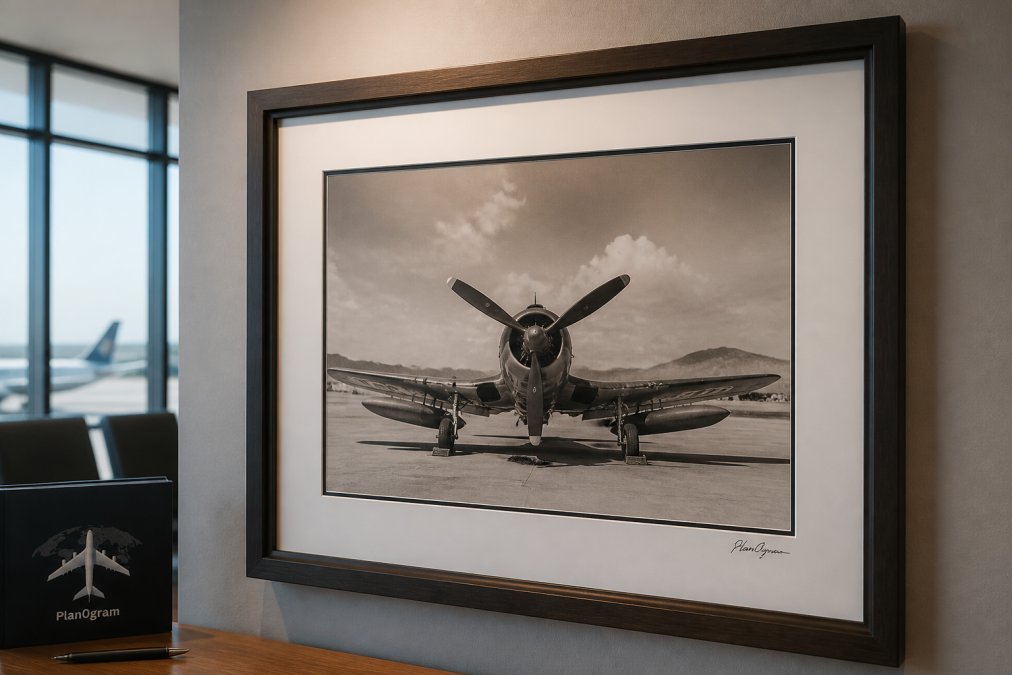
When choosing a framer, ask specifically about archival materials. If they don’t use acid-free matting and UV glass as standard, find another framer.
Display Considerations for Aviation Art
Where you hang your print matters as much as how you frame it.
Avoid direct sunlight: Even UV glass won’t protect indefinitely against direct sun. Hang prints in areas with indirect natural light or controlled artificial lighting. Avoid moisture-prone areas: Bathrooms and kitchens expose prints to humidity and temperature fluctuations causing warping, fading, and mold. Avoid high-traffic areas: Dust and accidental contact damage prints.
Lighting: Gallery-style track lighting or picture lights designed for artwork provide ideal illumination. Temperature stability: Maintain consistent room temperature between 65-75°F (si.edu). Humidity control: Ideal humidity is 40-50%; too dry causes brittleness; too humid causes mold.
Display aviation prints as museum pieces, they deserve that respect.
Investment vs. Decorative Value
Understanding your buying purpose changes strategy.
Investment prints appreciate over time. They’re typically limited editions with low print runs (under 500), signed by established artists with exhibition histories, produced using archival techniques with documented provenance. Investment prints require patience, value builds over years.
Decorative prints are chosen for aesthetic appeal. They might be open editions or higher-print-run limited editions selected for enjoyment rather than resale. There’s nothing wrong with decorative prints, just know which you’re buying. Don’t overpay for open editions thinking they’re investments, and don’t skip archival framing on decorative prints to save money.
The aviation print market has genuine collectors tracking values and appreciating rarity, plus casual buyers wanting beautiful aviation imagery. Both approaches are valid, be intentional about which you’re pursuing.
Your Next Step: Building Your Collection 🛫
Buying your first authentic aviation prints is the beginning. Serious collectors develop expertise over time, learning to spot quality, authenticate signatures, and recognize value.
Start by visiting galleries specializing in aviation art. Handle prints, ask questions, and develop your eye for quality. Join aviation enthusiast communities where collectors share knowledge. Follow artists whose work resonates with you.
Document everything you buy, keep certificates of authenticity, purchase receipts, and framed print photos. This documentation protects your collection’s value and simplifies future sales or insurance claims.
As your collection grows, consider professional appraisals for high-value pieces.
Building a collection of authentic aviation prints connects you to the artistry and history of flight. Whether decorating your home office, creating an aviation-themed gallery wall, or building an investment portfolio, the principles remain the same: buy from reputable sources, verify authenticity, preserve properly, and purchase what genuinely moves you.
At Plan0gram, we believe aviation art celebrates the beauty of flight from perspectives most people never experience. Explore our curated collection of fine art prints, canvas, and metal prints, each selected with the same passion that drives window-seat enthusiasts and aviation lovers. Get started building your collection today.
Frequently Asked Questions
Q: What defines an authentic aviation fine art print?
A: An authentic aviation fine art print is a reproduction created from an original artwork using museum-grade materials and techniques like giclee printing. It includes verifiable elements: the artist’s signature, a certificate of authenticity, numbered edition information, and documentation of provenance. The print uses archival-quality paper or canvas and is produced in limited quantities, distinguishing it from mass-produced posters or open-edition reproductions.
Q: How can I tell if an aviation print is a limited edition?
A: Limited edition prints display a numbering system (e.g., ’45/500′) indicating the print’s position in the edition run. Check for this numbering on the front or back of the print, and verify it against the certificate of authenticity. The artist or publisher should provide documentation of the total edition size. Be cautious of prints without clear numbering or certificates, as these are typically open-edition reproductions with lower collectible value.
Q: What should I look for in a certificate of authenticity for aviation art?
A: A valid certificate should include the artist’s name, print title, edition number and total run size, date of creation, artist’s signature or seal, and the issuing authority (artist, publisher, or gallery). It should be printed on quality stock and include a unique certificate number. Verify the certificate matches the print’s edition number and signature. Be wary of generic or photocopied certificates, authentic ones from established galleries or artists are printed professionally and difficult to counterfeit.
Q: Are signed aviation prints more valuable than unsigned ones?
A: Signed prints typically hold higher value in the collector’s market, especially when the signature is original rather than printed. A hand-signed limited edition print commands premium value because it represents direct authentication by the artist. However, value also depends on the artist’s reputation, the print’s condition, edition size, historical significance of the subject matter (military aviation, vintage aircraft, etc.), and provenance. A well-documented unsigned print from a renowned aviation artist may outvalue a signed print from an unknown creator.