Last Updated: October 19, 2026
This post contains affiliate links. As an Amazon Associate, Plan0gram earns from qualifying purchases, at no extra cost to you.
Is Extra Legroom Worth It? The Real Answer
The real question isn’t whether extra legroom seats exist. It’s whether paying for one improves your flight enough to justify the cost.
Extra legroom is worth it if you’re tall, flying long-haul, or simply can’t tolerate the standard economy pitch. It’s not worth it if you’re on a 2-hour regional flight, don’t mind aisle seats, or rarely fly.
Most travelers overpay for extra legroom they don’t need, while others skip it and regret it halfway through a transcon. The difference comes down to what you’re getting, what it costs relative to flight duration, and whether your body and travel pattern justify the upgrade.
Quick Answers
Are extra legroom seats worth it? They are if you’re tall, flying more than about 4 hours, or need to get up often. On a short flight, or if standard pitch already fits you, they’re usually not worth paying for.
Is a premium seat selection package worth the extra cost? Divide the fee by the flight time. If that hourly cost is something you’d happily spend on comfort, buy it. Check first whether your frequent flyer status gets you those seats free at check-in.
How much extra legroom do you actually get? Standard economy is usually 30 to 32 inches of seat pitch. Extra-legroom economy is typically 34 to 36 inches, exit rows 34 to 40, and premium economy about 38 inches with a wider seat.
>Extra Legroom vs. Standard Economy: What You Actually GetStandard economy seat pitch typically runs 30 to 32 inches (as tight as 28 on some budget carriers). Pitch is the distance from the back of one seat to the back of the seat in front.
In standard economy, a person around 5’8″ fits with knees slightly bent; taller passengers feel the squeeze immediately.
But extra legroom isn’t just about seat pitch. You also typically get:
- More under-seat storage space (standard economy often has limited room for a carry-on)
- Priority boarding on some carriers
- Direct aisle access if you book an aisle seat in the extra legroom section
- Sometimes a wider seat itself, depending on the aircraft configuration
What you don’t always get: better meals, lounge access, or premium amenities. Extra legroom is purely about physical space.
Airline Exit Row Seat Pros and Cons
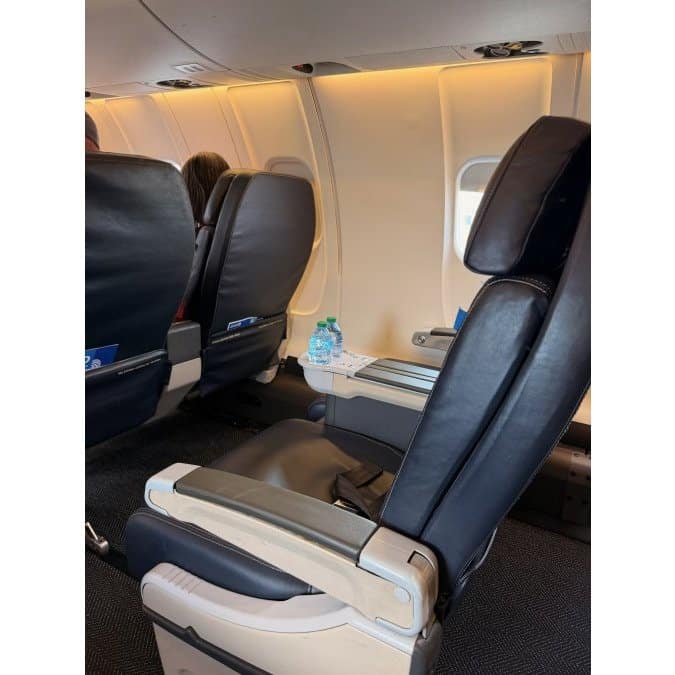
Exit row seats are the most misunderstood extra legroom option: cheaper than premium economy, but with real restrictions.
Pros of exit row seats:
- Significantly more legroom (typically 34-40 inches)
- Lower cost than premium economy upgrades
- Direct aisle access if you book the aisle seat
- No seat in front means you can stretch fully
Cons of exit row seats:
- Some exit rows don’t recline, usually the row directly in front of a second exit row
- No under-seat storage for takeoff and landing, so your personal item goes in the overhead bin
- Some exit rows sit next to the galley or a lavatory, which means more foot traffic and light
- Flight attendants will ask you to confirm you’re willing and able to help in an emergency
- In the US you must be at least 15, and you can’t sit there with an infant or a pet
Exit rows work best on flights under 4 hours, where recline doesn’t matter and you want maximum legroom at a reasonable cost. On a long-haul overnight, check the seat map first. A non-reclining exit row is a real problem if you plan to sleep.
Best Extra Legroom Seats for Long Flights
On 6+ hour flights, seat selection becomes critical. Not all extra legroom seats are created equal.

On long-haul flights, it helps to know there are two very different products:
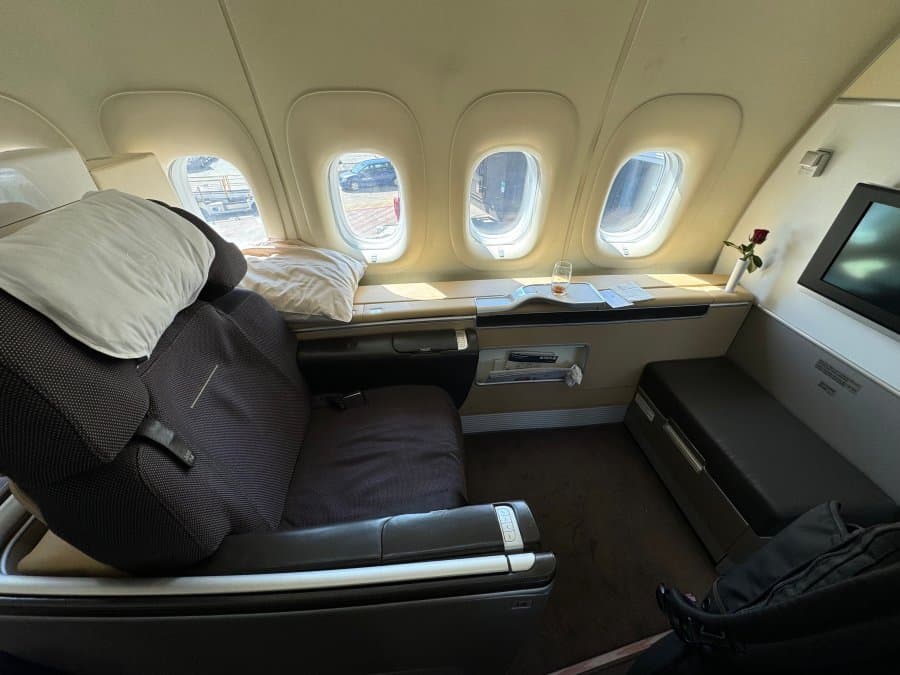
- Premium economy is its own cabin on most long-haul jets: roughly 38 inches of pitch, a wider seat, more recline, and better meals.
- Extra-legroom economy (United Economy Plus, American Main Cabin Extra, Delta Comfort) is the same economy seat with a few more inches of pitch, usually 34 to 36 inches, and often a better spot near the front of the cabin.
Exit row seats on long-haul are a mixed bag. The legroom is excellent, but if your row doesn’t recline, that is a real drawback on an overnight flight.
Bulkhead seats (the row behind a wall or partition) offer extra legroom but come with quirks: no under-seat storage, a smaller armrest-mounted tray table, and nearby lavatory doors.
Window or aisle? I am a window-seat person, and extra legroom makes the window even better: you can stand up and stretch without asking your row-mates to stand, and the view is still yours. An aisle seat in the same row is the pick if you get up a lot or want to reach the lavatory whenever you like.
Who Should Actually Pay for Extra Legroom
Here is a quick framework you can run in about 60 seconds at the seat map, before you pay.
The three-question test
1. Does the seat solve a physical problem? If your inseam puts your knees into the seatback at 31 inches of pitch, extra legroom is not a luxury, it is the difference between arriving functional and arriving wrecked.
2. How long is the exposure? Discomfort compounds. A tight seat on a 90-minute hop is an annoyance; the same seat on a transcon or long-haul is a cumulative problem. The value of extra pitch rises sharply past the 4-hour mark and again past 8 hours.
3. What does the specific seat give up? Extra pitch is not the only variable. Recline, armrest movement, under-seat storage, and lavatory proximity all move the math.
Decision matrix by traveler type and flight length
| Traveler profile | Under 3 hours | 3-6 hours | 6+ hours / overnight |
|---|---|---|---|
| Tall (roughly 6’2″+) | Worth it if the fee is modest | Usually worth it | Strongly worth it, prioritize recline-capable rows |
| Average height, standard pitch is fine | Skip | Skip unless the fare is bundled | Consider premium economy over exit row |
| Frequent mover / aisle-dependent | Aisle in the extra-legroom row | Aisle in the extra-legroom row | Aisle in premium economy |
| Budget-focused | Skip | Skip | Skip, or book early for a free exit row |
| Sleep-dependent | Skip | Marginal | Premium economy with full recline |
| Mobility or pain considerations | Worth it for easier standing | Worth it | Worth it, book early and request assistance |
The cost-per-hour sanity check
Before you pay, divide the upgrade fee by the scheduled flight time for a rough cost per hour of added comfort. Then ask: is that hourly figure something you’d spend on a meal, a drink, or a rideshare to avoid discomfort? If yes, the upgrade makes sense. If the number feels absurd, it probably is, and the same money often goes further on gear you’ll use every trip, like a compact foot hammock or a lumbar cushion that packs flat.
Traveler-type notes
- Tall travelers: The break-even is shortest for you. On a 5-hour flight, even a modest fee is usually justified because the alternative is genuine pain.
- Frequent flyers with status: Check whether extra-legroom rows are complimentary at check-in or selectable at booking. Many programs release them to elite members, which changes the value calculation entirely.
- Business travelers: If the upgrade is reimbursable or bundled into a corporate fare, take it on any flight over 3 hours. If it is out of pocket, run the cost-per-hour check.
- Families and groups: Exit rows require each occupant to meet eligibility rules, and some carriers restrict them for travelers under a certain age or with an infant. If you need to sit together, the extra-legroom row may not be bookable as a block, verify before you pay.
- Travelers with mobility or medical needs: Extra legroom is often the most valuable upgrade because it makes standing, stretching, and reaching the aisle easier. Book early, request assistance in advance, and confirm the seat type, a bulkhead with a fixed armrest can be harder to exit than a standard aisle seat.
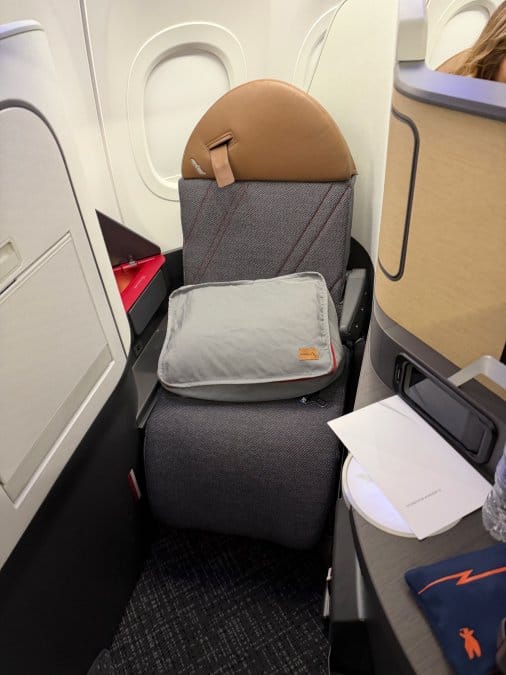
Choosing the right seat comes down to understanding your own comfort priorities and being honest about what actually matters on your route. Whether extra legroom is worth it depends on who you are and how long you’re flying. The best seat isn’t always the most expensive one, it’s the one that solves your specific problem.