
Table of Contents
- Why the Best Seat Is Never Random ✈️
- How to Read an Aircraft Seat Map Like a Pro 🗺️
- Best Airplane Seat Map Tools to Check Before You Book 🛠️
- How to Avoid Obstructed Window Seats (Wing, Galley & Lavatory) 🚫
- Choosing the Shady Side: Sun Glare, Flight Path & Sun Trajectory 🌞
- Best Seat for Photography: Shooting from 35,000 Feet 📸
- Step-by-Step: How to Lock In the Best Seat for Your Next Flight 🎯
- Frequently Asked Questions
Why the Best Seat Is Never Random ✈️
The best seat on any flight comes down to understanding aircraft geometry, sun trajectory, seat map alignment, and cabin configuration quirks. At Plan0gram, we’ve spent 34+ years and over 3 million miles chasing the perfect view from 35,000 feet. Most travelers leave their seat choice entirely to chance, a mistake that turns a transcontinental haul from ORD to LAX into a frustrating experience.
A misaligned window, a wing blocking your horizon, or blinding afternoon sun can ruin hours of flight time. With the right tools and pre-flight homework, you can lock in a great seat almost every time. Below, we’ll walk through how to read aircraft seat maps, which tools to trust, how to dodge obstructed views, and how to choose the shady side for your specific route, plus photography-specific seat selection, a topic most guides skip entirely.
One critical point upfront: not all window seats are equal. The difference between seat 14A and 22A on a 737-800 can mean the difference between an unobstructed panorama and a wall of aluminum wing.
How to Read an Aircraft Seat Map Like a Pro 🗺️
Most travelers glance at a seat map, pick a window row, and move on. That leaves a lot on the table.
Cabin Configuration: Economy, Premium Economy & Business Class
The fuselage is divided into distinct zones where seat pitch, width, and window alignment differ significantly. Business class on wide-body jets like the 777 or A350 typically features deliberate window alignment. Economy, especially in high-density configurations, often compresses rows so windows no longer line up with seats.
On narrow-body aircraft (737 family, A320 family), roughly one window per row exists in economy, but alignment shifts depending on the airline’s cabin fit-out. Premium economy on long-haul wide-bodies offers better window-to-seat alignment than standard economy due to reduced row counts.
Key cabin configuration terms:
- Seat pitch: Distance from one seat back to the same point on the seat in front. Standard economy runs around 30-31 inches on domestic routes.
- Seat width: Measured between armrests. Wide-body aircraft typically offer slightly more width per seat.
- Cabin zones: Forward, mid-cabin, and aft each have different noise levels, boarding priority, and lavatory proximity.
Identifying Misaligned Windows on the Fuselage
A misaligned window doesn’t line up with any seat. This happens when airlines reconfigure cabins, add or remove rows, or fit higher-density layouts than the original design intended. Seat 11A might have a perfectly centered window. Seat 12A might have a window partially behind the divider. Seat 13A might have only a blank wall.
The only reliable way to catch this before boarding is using a to-scale seat map tool, not the generic diagrams most airline booking engines show.
Best Airplane Seat Map Tools to Check Before You Book 🛠️
Generic airline booking engines show simplified cabin diagrams that tell you almost nothing about actual window placement, legroom, or obstruction risk.
AeroLOPA is a technically precise option. It offers to-scale seat maps with window alignment overlaid on actual fuselage geometry, color-coded seat ratings, and tail number predictions within 24 hours of departure so you know the exact aircraft configuration. It’s available on iOS and Android, with a free web tier and paid app access.
Other useful approaches include checking airline apps (which often show more detail than websites), crowd-sourced seat review forums, and researching specific aircraft types before booking. According to Boeing’s commercial aircraft documentation, even within the same aircraft family, cabin configurations vary significantly between operators.
Summary: Seat Map Tool Comparison
|
Tool |
Window Alignment |
Tail Number Prediction |
Free Access |
|---|---|---|---|
|
AeroLOPA |
Yes, to scale |
Yes (24hr out) |
Web free, app paid |
|
Airline app |
Schematic only |
No |
Yes |
|
Community forums |
Crowd-sourced |
No |
Yes |
How to Avoid Obstructed Window Seats (Wing, Galley & Lavatory) 🚫
Obstruction is the enemy of the best window seat, and it comes in three forms: the wing, the galley, and the lavatory.
Wing Obstruction: Where the View Disappears
On a typical 737-800, the wing covers roughly rows 12 through 20. On wide-bodies like the 777-300ER, the obstruction zone shifts further forward. Seats directly over the wing get the worst obstruction.
The seats just aft of the wing trailing edge actually offer excellent views, you’re clear of obstruction and over the rear fuselage where the plane curves away. Forward cabin seats ahead of the wing leading edge similarly offer clean sightlines.
Galley Noise and Lavatory Proximity: The Silent Comfort Killers
Seats near the galley mean carts, crew activity, and ambient noise throughout the flight, especially on overnight long-haul sectors. Seats within two rows of a lavatory see constant passenger traffic, disrupting personal space and making sleep difficult.
Use AeroLOPA or a detailed seat map tool to identify lavatory and galley positions before booking, then select a seat at least three rows clear of both.
Choosing the Shady Side: Sun Glare, Flight Path & Sun Trajectory 🌞
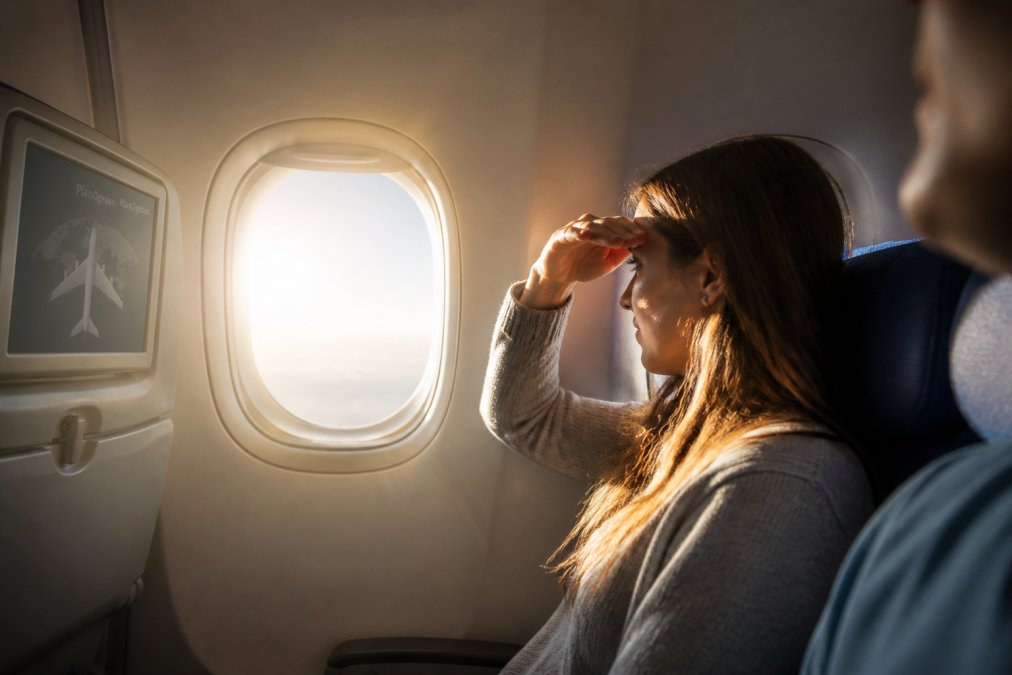
Choosing the shady side of the plane is one of the highest-impact decisions for daytime flight comfort, and almost nobody thinks about it at booking.
The sun’s position depends on three variables: departure time, flight path, and aircraft heading. A westbound midday flight has the sun on the right side (A-seats). An eastbound morning departure has the sun blazing through starboard windows (higher-letter seats).
General rules for common domestic routes:
- Eastbound morning flights (e.g., LAX to JFK): Sun is behind you early, then tracks right. Choose left-side seats (A-side) for shade.
- Westbound afternoon flights (e.g., JFK to LAX): Sun is ahead and right. Left-side seats (A-side) stay shaded most of the flight.
- Northbound flights: Sun stays to your right (east) in morning, shifts overhead by midday. Either side works for afternoon departures.
- Southbound flights: Similar logic reversed. Morning sun hits the left side.
For precise sun trajectory mapping, the National Oceanic and Atmospheric Administration’s solar calculator lets you calculate sun angle and azimuth for any time and location, cross-referenced with your flight path.
Best Seat for Photography: Shooting from 35,000 Feet 📸
The best seat for aerial photography combines position, cleanliness, and obstruction clearance that most travelers never optimize for.
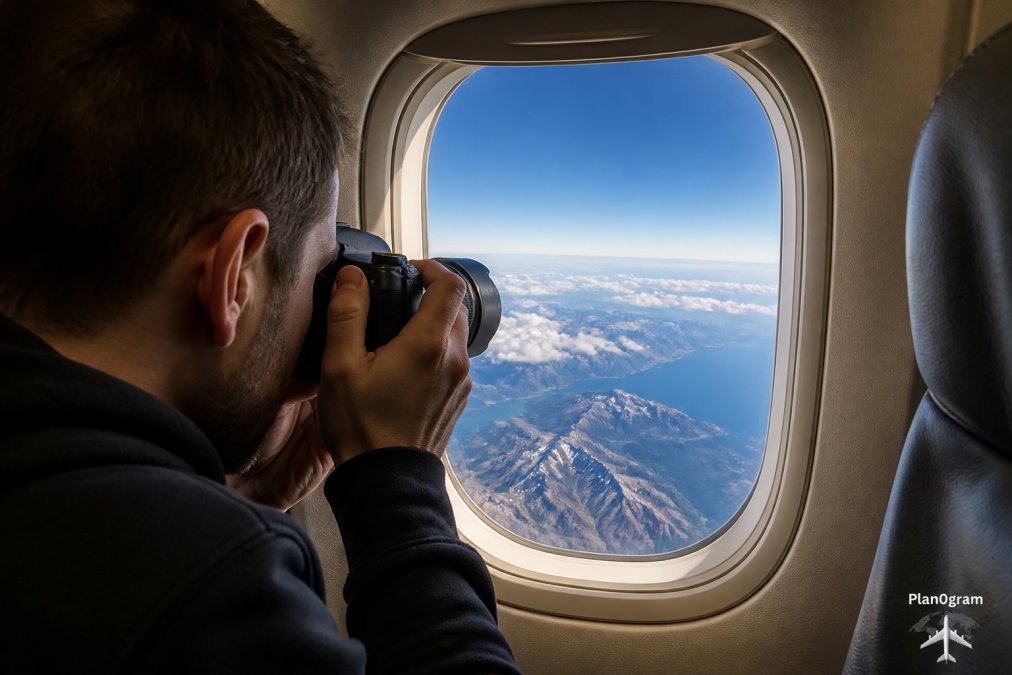
The window itself matters as much as the seat. Aircraft windows have inner, outer, and middle panes. Scratches, condensation, and haze degrade image quality. Always inspect the window before committing to a seat at the gate. If it’s compromised, ask a flight attendant about alternatives.
Front vs. Rear of the Cabin for Clean Shots
Forward cabin seats ahead of the wing give clean forward-facing views with no engine exhaust haze. Engine exhaust from underwing-mounted engines creates heat shimmer visible in photos taken from seats directly aft of the engine cowling.
Rear cabin seats behind the wing trailing edge offer clean downward and rearward perspectives, excellent for capturing the aircraft’s shadow on clouds or terrain. On approach and departure, rear cabin windows often frame the most dramatic landscape angles.
The sweet spot is consistently the first two rows ahead of the wing leading edge, or the first two rows behind the trailing edge, both deliver obstruction-free shots.
Spotting and Avoiding ‘Fake’ or Blocked Windows
‘Fake’ windows are a real phenomenon. On some aircraft, particularly older narrow-bodies that have undergone cabin refits, the exterior fuselage retains window cutouts that are blanked off on the interior.
How to identify them before boarding:
- Cross-reference the seat map in AeroLOPA with the aircraft’s known fuselage window count for that specific variant.
- Look for seats that community reviews flag as “no window” or “half window.”
- On the aircraft itself, check the row before stowing your bag. If the window looks unusually small or has a non-standard frame, it may be partial or blanked.
According to the FAA’s aircraft certification documentation, blanked windows are structurally sound but genuinely inconvenient for passengers expecting a view.
Window Seat vs. Aisle Seat: Legroom, Recline & Accessibility Trade-Offs
The window versus aisle seat debate depends entirely on what you’re optimizing for.
Window seat advantages:
- Unobstructed views (when properly selected)
- A wall to lean against for sleep
- No interruptions from neighbors needing to pass
- Better for photography and aviation enthusiasts
Window seat disadvantages:
- You’re trapped; getting up requires disturbing seatmates
- Slightly reduced legroom on some aircraft
- Exit row window seats sometimes have non-reclining backs
- Accessibility is significantly harder for passengers with mobility considerations
Aisle seat advantages:
- Freedom to stand, stretch, and access overhead bins without asking
- Better for passengers with mobility considerations or medical needs
- Slightly more elbow room
Aisle seat disadvantages:
- Cart strikes happen more than airlines admit
- You’re the de facto exit for your entire row
- No view and no wall to lean on
For leisure travelers flying three to four times yearly, the window seat almost always wins if you’ve selected a clean, aligned, unobstructed position. For frequent business flyers prioritizing sleep and aisle access, the calculus shifts.
Window vs. Aisle: Quick Reference
|
Factor |
Window Seat |
Aisle Seat |
|---|---|---|
|
View quality |
Excellent (if well-chosen) |
None |
|
Sleep comfort |
Good (wall to lean on) |
Interrupted by traffic |
|
Aisle access |
Requires disturbing neighbors |
Immediate |
|
Legroom |
Slightly reduced at floor |
Marginally better |
|
Accessibility |
Difficult |
Best option |
|
Photography |
Ideal |
Not applicable |
As documented in FAA guidelines on passenger accessibility and seating, airlines must accommodate passengers with disabilities, and aisle seats are often the recommended default for mobility-impaired travelers.
Step-by-Step: How to Lock In the Best Seat for Your Next Flight 🎯
Here’s the process to use for every flight, whether a 90-minute hop or 14-hour transoceanic sector.
Total Time: 15-20 minutes of pre-flight planning
- Identify your aircraft type. Check your booking confirmation or airline app for the specific variant (e.g., 737-900, A321neo, 777-300ER).
- Pull up AeroLOPA or a to-scale seat map tool. Search your flight number and verify the seat map matches your aircraft variant, checking window alignment for each available window seat.
- Eliminate obstructed seats. Cross off any seat over the wing (unless specifically after a wing shot), within two rows of a lavatory, or adjacent to the rear galley.
- Determine the shady side. Use your departure time and route direction to figure out which side will be in shade for most of the flight. For photography, factor in where the best landscape features will be visible.
- Check for misaligned or blank windows. Look for community notes flagging “half window,” “no window,” or “window between seats” for your specific rows.
- Select your seat and set an alert. If your preferred seat is taken, use a seat alert function if available. Seats often free up at online check-in, 24 hours before departure.
- Recheck within 24 hours of departure. Confirm the tail number hasn’t changed. Aircraft swaps happen, especially on domestic routes. If the aircraft changes, repeat steps 2 through 6.
- Inspect the window at the gate. Before settling in, check the window for scratches, haze, or condensation. If compromised, ask about alternatives early.
The Plan0gram community, built around 34+ years of window-seat expertise, has refined this process across hundreds of routes and aircraft types. Whether you fly three times a year or three times a week, these eight steps will consistently put you in a better seat than leaving it to the algorithm.
Frequently Asked Questions
Q: How can I tell if a window seat is actually missing a window?
A: Before booking, cross-reference your row number against a to-scale aircraft seat map on a tool like AeroLOPA. Fuselage windows don’t align perfectly with every seat row, so some window seats — especially in exit rows or where the cabin configuration shifts — sit next to a blank fuselage panel. On the actual aircraft, you’ll see a solid wall where the oval cutout should be. Checking the seat map before you print that boarding pass is the only reliable fix. 🪟
Q: Which window seat is best for viewing the landscape on a long-haul flight?
A: For the best window seat on a long-haul flight (LHR-JFK, LAX-NRT, etc.), choose a row ahead of the wing on the shady side of the aircraft. The shady side depends on your flight path and departure time — eastbound daytime flights generally favor the left side (A seats) to avoid direct sun. Rows 10-15 on most widebody aircraft sit ahead of the wing obstruction and offer an unobstructed view of terrain, coastlines, and cloud formations. ✈️🌍
Q: Does the wing location affect the quality of a window seat?
A: Absolutely. The wing sits roughly mid-cabin, and the rows directly above it — typically rows 15-25 on a 737 or A320 — have their view partially or fully blocked by the engine and wing structure. On widebody aircraft like the 777 or A350, the obstruction zone is wider. Seat map tools that show to-scale cabin configurations make it easy to see exactly which rows fall in the wing shadow before you commit to a seat. 🛫
Q: Are window seats at the back of the plane better for photography?
A: Rear window seats (behind the wing) give you a rearward angle past the trailing edge, which works well for runway departure shots and cloud-scape photography. The trade-off: engine exhaust heat shimmer from rear-mounted engines (common on 717s and CRJs) can blur images. For the best window seat for photography, the sweet spot is 3-5 rows ahead of the wing — clean glass, no heat distortion, and a forward-looking angle that captures landscapes as you approach them. 📸🏔️
This article was written using GrandRanker