

This post contains Amazon affiliate links. As an Amazon Associate, Plan0gram earns from qualifying purchases, at no extra cost to you.
Not medical advice: this article is general travel information from a frequent flyer, not medical advice. Talk to your doctor or pharmacist about what’s right for you, especially before using any medication.
Last Updated: September 28, 2026
Why Your Ears Hurt on Descent (and Not at Cruising Altitude)
Here’s the odd part of flying: your ears feel fine, then LAX or JFK sneaks up and your head feels like it’s in a vise. Ear pain during airplane descent is barotrauma, a pressure mismatch between the cabin and your middle ear. At cruise, cabin pressure holds steady. On descent, it climbs fast, and your eustachian tube has to keep up.
That tube is your ear’s pressure relief valve. It connects your middle ear to the back of your throat and usually opens when you swallow or yawn. If it’s blocked by a cold or sinus congestion, pressure builds against the eardrum. The result: ear discomfort, muffled hearing, and sometimes dizziness.
This guide covers how to prevent ear pain during airplane descent, drawn from 34 years and 3 million miles in the air: step-by-step techniques, timing, and tactics for kids.
Source: MedlinePlus guide to ear barotrauma
The Valsalva Maneuver for Flying: Step-by-Step
The Valsalva maneuver is the quickest way to equalize pressure. Close your mouth, pinch your nose, and blow gently, the same way you’d clear your ears on the ground. Air moves up the eustachian tube and balances the middle ear.
Do it right:
- Pinch your nostrils shut with two fingers.
- Take a normal breath in.
- Close your mouth and blow softly for 2-3 seconds.
- Stop the moment you feel a pop or click.
- Swallow once to confirm.
Keep it gentle. Blowing hard can hurt your ears rather than help them.
Tip: Set a phone alarm for about 30 minutes before landing. Timing beats technique: start equalizing at the top of descent, not when the wheels are about to come down.
I’ve watched too many people nail the maneuver at 5,000 feet and still land in pain, but they were also severely congested.
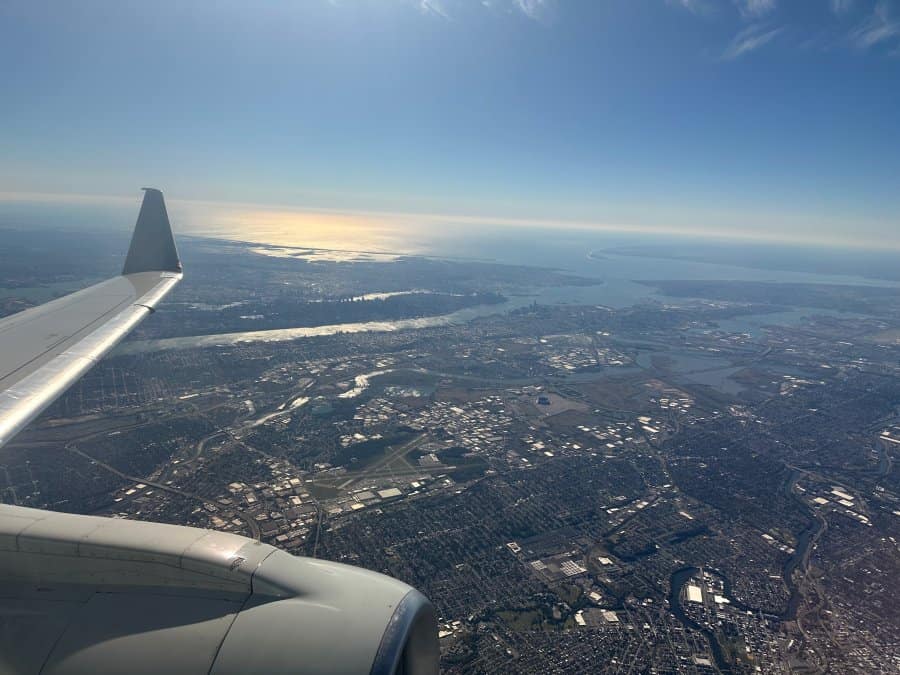
Own this view: Aerial View Over New York Cityscape, available as a fine art print.
Pressure-Regulating Earplugs: Do They Actually Work?
They help, but as a supporting act. Pressure-regulating earplugs slow the rate of pressure change reaching your eardrum. They don’t open your eustachian tube, so you still need to swallow, yawn, or do the Valsalva.
What they do well:
- Cushion the pressure change during descent
- Take the edge off mild ear discomfort
- Help on short hops where you can’t time a full routine
What they don’t do:
- Clear a fully blocked eustachian tube
- Replace a decongestant when you’re congested
- Fix fluid buildup behind the eardrum
Put them in before the top of descent and leave them in through touchdown.
Decongestants for Air Travel: Timing and Options
If you’re congested, a decongestant only helps if it’s already working when descent begins. That means taking it ahead of time, not when your ears start to hurt.
Nasal sprays (oxymetazoline, phenylephrine)
- Oxymetazoline (Afrin and store brands) works within minutes and lasts up to about 12 hours.
- Phenylephrine nasal spray is shorter-acting.
- Don’t use either for more than three days in a row; overuse causes rebound congestion.
Oral decongestants (pseudoephedrine, phenylephrine)
- Pseudoephedrine (the Sudafed kept behind the pharmacy counter) usually starts working in about 30 minutes and lasts several hours, longer for extended-release versions.
- Oral phenylephrine (the version on the open shelf) is a poor choice. An FDA advisory panel concluded in 2023 that it doesn’t work as a decongestant when taken by mouth.
Timing: if you’re congested, take a decongestant about 30-60 minutes before descent, following the label directions. Then keep swallowing, chewing gum, or sipping water through the final part of the descent.
Check with a doctor or pharmacist first if you:
- Have high blood pressure, heart disease, or an irregular heartbeat
- Have prostate problems or trouble urinating
- Are pregnant or breastfeeding
- Take other medications regularly
Pseudoephedrine can also make it hard to sleep, so think twice before taking it on a red-eye. Antihistamines like loratadine help only if your congestion is allergy-driven, and older ones like diphenhydramine cause drowsiness.
Source: CDC Yellow Book: Air Travel
Swallowing, Yawning, and Other In-Flight Techniques
Swallowing and yawning are the simplest tools to prevent ear pain during airplane descent. Both open the eustachian tube without force, and chewing gum or sucking on hard candy keeps you swallowing on repeat.
Your in-flight toolkit:
- Chew gum or suck a hard candy through descent
- Yawn wide, even if you feel silly
- Take small sips of water every few minutes
- Try the Toynbee maneuver: swallow with your nose pinched and mouth closed
- Stay awake for descent; you swallow less when you’re asleep
- Sit upright rather than slumped
Technique | Best For | When to Start |
|---|---|---|
Valsalva maneuver | Quick equalization | Top of descent |
Swallowing/yawning | Mild pressure | About 30 min out |
Chewing gum | Continuous swallowing | Before descent |
Earplugs | Slowing pressure change | Before top of descent |
Decongestant | Congestion | 30-60 min before descent |
How to Help Infants and Children Avoid Ear Pain on Flights
Kids feel descent pressure more than adults. Their eustachian tubes are shorter and narrower, so they block more easily. For children, it’s mostly about timing, not medicine.
What works:
- Feed a bottle or breastfeed during descent, since sucking triggers swallowing
- Offer a pacifier if they won’t eat
- Keep them awake for landing if you can
- Older kids can chew gum, sip a drink through a straw, or wear kid-size pressure-regulating earplugs
- Give a decongestant only if their doctor approves it for their age
Important: If your child has an ear infection, cold, or fever, check with their pediatrician before flying. A swollen tube makes descent much more painful, and a doctor can tell you whether to fly or wait.
Post-Flight Recovery and When to See a Doctor
Most blocked ears clear up within hours of landing. Here’s how to help that along, and when to stop waiting it out.
The first few hours after landing
- Keep swallowing and yawning on the walk to baggage claim. Chewing gum helps.
- Stay upright.
- Use a saline nasal spray (plain salt water, not a medicated spray) to keep your nose clear.
- Steam from a hot shower can help.
- If you can, avoid flying again the same day.
If your ears are still blocked a day or two later
- Try a gentle Valsalva or Toynbee maneuver a few times, but stop if it hurts.
- A warm compress over the ear can ease discomfort.
- Over-the-counter pain relief (acetaminophen or ibuprofen) can help with soreness.
- Avoid forceful nose-blowing.
Travelers with existing conditions
- Chronic sinus problems or allergies: ask your doctor whether to start a steroid nasal spray several days before the trip.
- Recent ear surgery or a perforated eardrum: ask your ENT before flying.
- Eustachian tube dysfunction: talk with your doctor about a plan before you fly.
- Children with recurring ear infections: have them checked before a trip.
When to see a doctor
Book an appointment or visit urgent care if you have:
- Severe pain, or pain that doesn’t fade within a few hours of landing
- Hearing loss that lasts more than a day or two
- Ringing in the ears, especially in one ear only
- Dizziness or a spinning sensation
- Fluid, blood, or pus draining from the ear
- Fever along with ear pain
Important: A ruptured eardrum from descent is rare, and it usually follows flying while congested. If you felt sharp pain, then sudden relief followed by muffled hearing or drainage, get it checked promptly.
Source: American Academy of Otolaryngology patient resources
My Descent Kit, in One Click
Two things worth packing for every flight: pressure-regulating earplugs and a travel-size saline spray (under 3.4 oz, so it’s fine in your carry-on). Add both to your Amazon cart in one click, or grab the family version with kids’ earplugs. Pack gum or hard candy and you’re set.
The Bottom Line
Descent is the one phase of flight where a little planning beats a lot of pain. Start your routine at the top of descent, keep swallowing, and don’t wait for the pressure to win.
Every approach has a view worth staying awake for, and a few of mine ended up in my gallery of window-seat and airport prints. For airport-by-airport tips, see my airport guides.
Not medical advice. If ear pain is severe or doesn’t go away, see a doctor.