Why the Window Seat Still Wins for City Views
The best window seats for viewing city skylines are the ones that put a major downtown grid on your side of the airplane, at the right angle, at the right time of day. That sounds simple. It is not.
We have spent years chasing this. Our founder still picks flights partly on what the approach looks like. A window seat on the wrong side is just a seat. A window seat on the right side is the best part of the trip.
Here is the thing most guides miss: the view is not about the seat letter. It is about geometry, sun, and timing. Get those three right and a basic economy window seat beats a lie-flat suite facing a blank wing.
Below, we break down side selection, seat maps, route planning, landing approaches, and the weather calls that decide whether you see a skyline or a gray smear.
Which Side of the Plane to Sit On for Views
The short answer: sit on the side that faces the city as you approach. There is no universal left-or-right rule, because it depends on which runway is in use and how the airplane turns onto final. Check the route every time.
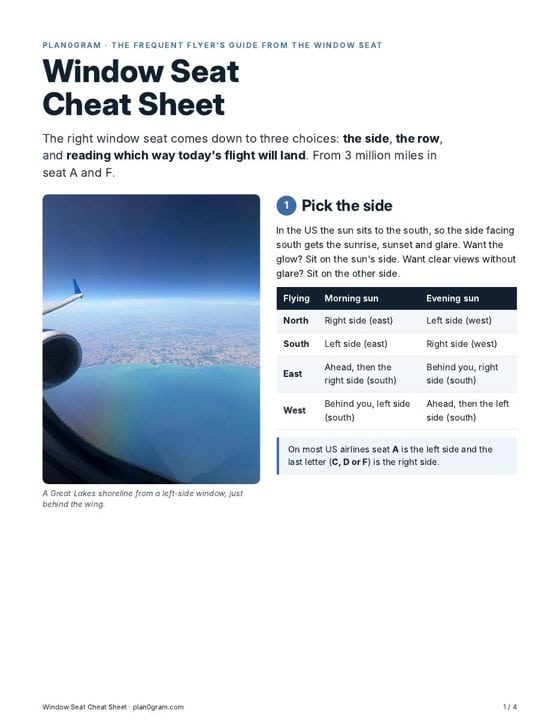
Think about the sun first. In the US, the sun sits in the southern part of the sky for most of the year. Flying east, south is on your right. Flying west, south is on your left. Sit on the sun side for golden light on the city, or the shade side if you want photos without glare.
Then think about the approach path. Cities sit on coastlines, rivers, and bays, and the runway decides which side gets the downtown view. Our guide to choosing the best seat on any flight walks through how aircraft geometry and sun trajectory stack up together.
Practical moves:
- Pull up the arrival airport on a map before you book
- Note where downtown sits relative to the runway
- Check sunrise and sunset times for your flight date
- Prefer the side facing the city on descent, not departure
How to Choose a Window Seat on a Plane
Choosing a window seat on a plane comes down to four checks: seat letter, seat map, fuselage position, and booking timing. Run all four and you will rarely end up staring at an engine cowling.
1. Confirm the seat letter. On narrowbodies, A and F are windows. On widebodies, A and K are common, though airlines vary. Never assume. Open the seat map and confirm the window icon.
2. Check for a missing window. Some window seats line up with a wall panel or have no window at all. Seat-map review sites flag these rows, so check before you commit.
3. Pick your fuselage position on purpose. Forward of the wing gives you a clean forward view and a faster exit.
4. Book early and set an alert. Window seats in the forward cabin go first, often within the first day or two of schedule load.
A repeatable process for frequent flyers:
- At booking: pull the seat map, confirm the aircraft type, and pick a window forward of the wing on the side your route map suggests.
- At 24 hours out: recheck the seat map for equipment swaps and move if the window line shifted.
- At check-in: confirm the seat is still a window, not a middle, and ask the gate agent if a better window opened up.
- On board: if the window is plugged, ask a flight attendant about a move after boarding only if the cabin is open and you are not blocking anyone.
Practical gear that genuinely helps on a long window-seat leg: a thin travel blanket, a memory-foam neck pillow, and a compact eye mask for the bright side of the airplane.
Watch out: booking a “window” seat on an exit row without checking the seat map can land you next to a plugged window with no view at all. Our roundup of tips for avoiding bad airplane seat views covers these traps, and our guide on how to find the best window seat goes deeper on airline-specific quirks.
Using a Flight Route Map for Seat Selection
A flight route map for seat selection shows the path your airplane will fly, and that path tells you which side faces the city on arrival. Most people never look at it. That is free information going to waste.
Open a flight tracking website and pull a recent flight with the same number and route. Look at the last twenty minutes of track. You will see the downwind leg, the base turn, and the final approach. Whichever side faces the downtown core during that turn is your side.
A few US hub patterns worth memorizing:
- BOS: the harbor approach can put downtown Boston on one side of the airplane depending on the active runway; our Boston Logan guide covers the runway-by-runway view.
For business travelers on repeat routes, build a small habit:
- Save the track for your regular city pairs in a notes app or a spreadsheet.
- Note the side that worked and the runway in use that day.
- Recheck when the active runway, the aircraft type, or the schedule changes.
- Screenshot the seat map at booking and again at check-in, because equipment swaps happen.
Runway changes happen with wind and construction. A route that gave you a perfect skyline last spring can hand you a view of a warehouse park in the fall. A common pattern is that the same flight number flips sides between seasons as prevailing winds shift.
Watch out: flight-tracking history shows what the airplane actually flew, not what it will fly on your date. Treat the track as a hint, not a guarantee, and recheck the day before departure.
Best Window Seats for Landing Views
The best window seats for landing views sit just behind the wing on the side facing downtown, where the turn reveals the skyline without the wing cutting across it. Forward of the wing is a close second on straight-in approaches.
Landing is where the payoff lives. Departures climb fast and the city drops away before you get a good look. Arrivals give you the turn, the descent, and the slow reveal.
A few patterns worth knowing:
- Coastal cities often approach over water, so the ocean side gets the skyline
- River cities tend to line up along the water, putting downtown on one bank
- Inland hubs with parallel runways can flip your side depending on which runway is active
If you want the home-airport version of this, our Boston Logan guide names the best window seat views on approach into a major hub. The same logic travels.
Window-seat comfort matters here too. A thin blanket, a neck pillow, and a seat away from the lavatory make the last hour pleasant instead of cramped. Small gear, big difference.
Wing Obstruction and Seat-Selection Tradeoffs
Wing obstruction is the quiet killer of a good view. The wing and engine block a huge slice of your sightline, and no amount of planning fixes a seat sitting right over the powerplant.
Rows over the wing are the obvious problem. Less obvious: the row just ahead of the wing can still catch the leading edge in your frame, and the row just behind can catch the trailing edge and flap track fairings.
There is a real tradeoff here. Exit rows give legroom and often sit near the wing. Bulkheads give space but sometimes have misaligned windows.
What most guides miss is that the engine placement matters more than the wing itself on some widebodies. Sit ahead of the engine and you get a clean cone of vision. Sit beside it and you get a metal wall.
Watch out: booking a “window” seat on an exit row without checking the seat map can land you next to a plugged window with no view at all. Our roundup of tips for avoiding bad airplane seat views covers nine of these traps.
Problem | Fix | Impact on View |
|---|---|---|
Seat over the wing | Move several rows forward or aft | Removes wing and flap obstruction |
Exit-row window | Check seat map for window gaps | Avoids a plugged or missing window |
Engine beside seat | Sit ahead of the engine | Opens a clean sightline |
Wrong side for approach | Check route map and runway | Puts the skyline on your side |
Late booking | Set a seat alert early | Keeps the window you want |
Timing, Weather, and Visibility Conditions
Timing decides more than seat choice. A perfect seat on a hazy afternoon loses to a decent seat at twilight on a clear evening.
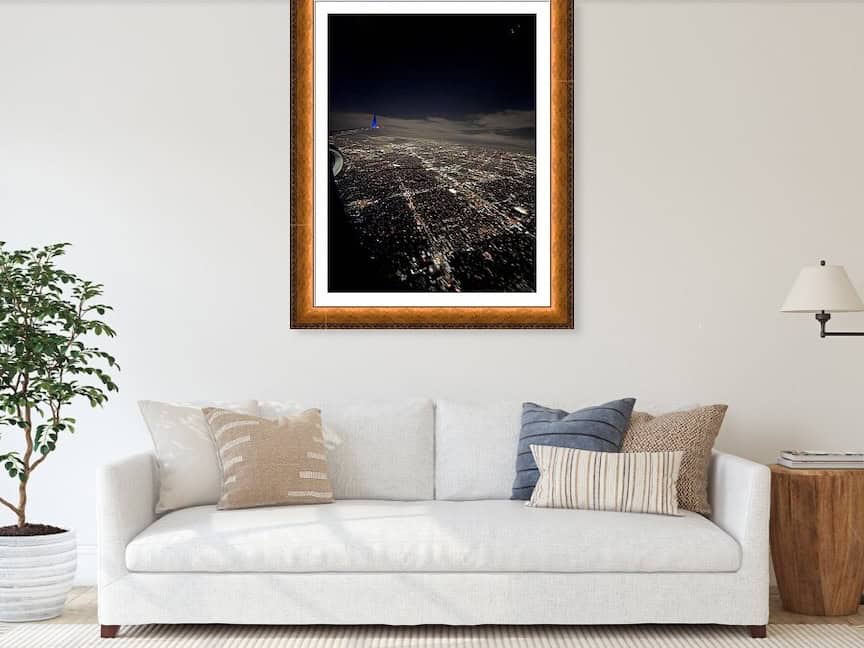
Sunset and twilight are the sweet spot. Natural light drops, city lights come up, and the skyline reads as a skyline instead of a gray grid. Nighttime flights over a lit downtown are the reward for a late arrival.
Weather is the wild card. Overcast conditions at the arrival airport can erase the whole view, and summer haze softens distant skylines into mush. Check the forecast for the arrival city, not the departure city, a day out.
Then check the visibility. Clear evenings after a front passes give the sharpest views. Humid summer afternoons give you glow and not much else.
One insider tip: listen to the descent announcement. Some pilots mention which direction you are landing, and that tells you which side wins. If you are on the wrong side and the cabin is open, a polite ask to move after boarding can occasionally work.
Lock In Your Skyline Seat Before Boarding
The seat you book is a guess. The seat you keep is the result of a plan. Check the route, pick the side, avoid the wing, and watch the weather. Then confirm it all at check-in.
That last step matters. Seat maps shift, equipment swaps happen, and the window you picked can quietly turn into a middle seat. Our guide on requesting a window seat at check-in shows when to ask.
At Plan0gram, our founder brings over 34 years of flying experience to the question of which seats deliver. We publish airport guides, gear reviews, and window-seat advice. If you want to fly smarter and see more from 35,000 feet, start with the seat.
The difference between a forgettable flight and a great one often comes down to one decision made weeks before boarding. Plan0gram helps you make it with airport guides, gear reviews, and seat strategy drawn from more than three decades in the air. Explore our airport lounge guides, honest gear breakdowns, and window-seat playbooks to plan your next trip with confidence.